

[ONLINE] Jurisdictional Risk in Practice: Moving Beyond Country List to a Defensible AML/CFT Risk assessment – 25 February
This practical CPD course examines how subject persons can develop a more meaningful and defensible approach to assessing jurisdictional risk. It explores the different factors that may contribute to geographic risk, including exposure to countries identified as presenting elevated ML/FT risks, weaknesses in AML/CFT regimes, corruption, organised crime, sanctions exposure, tax crime, and other relevant country-specific factors.
Seminar Description
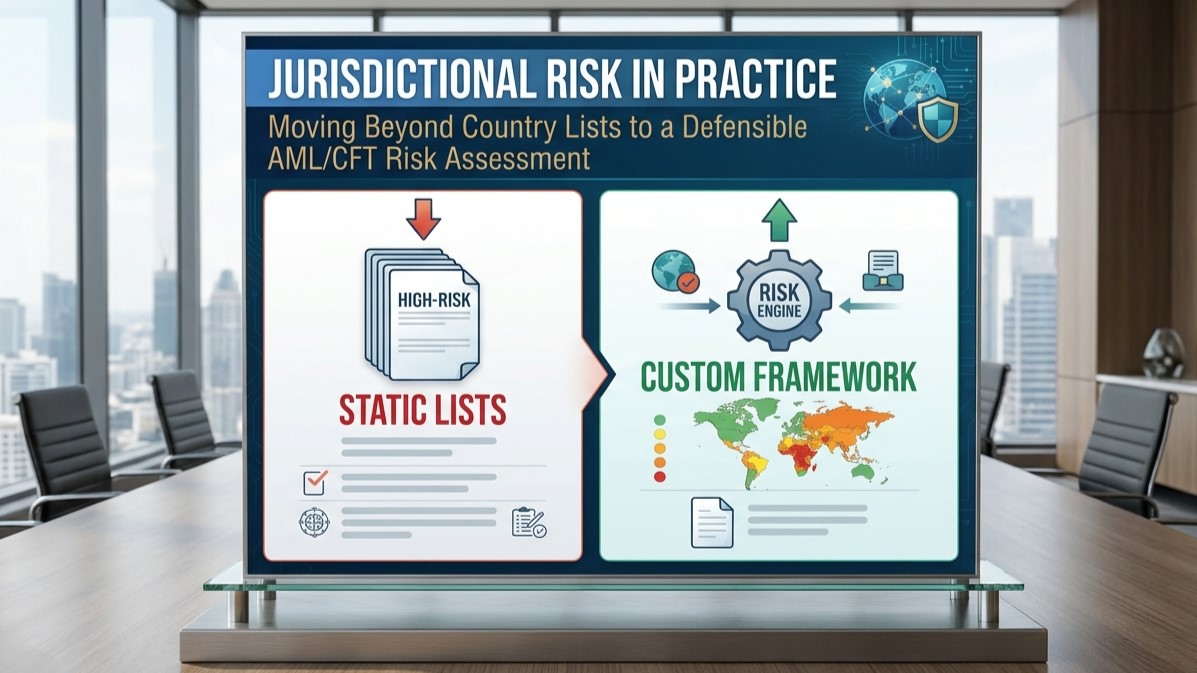
Geographic or jurisdictional risk is a fundamental component of an effective AML/CFT risk assessment. However, treating jurisdictional risk as a simple list of “high-risk” and “low-risk” countries can result in an overly simplistic assessment that fails to reflect the actual risk posed by a customer, transaction or business relationship.
This practical CPD course examines how subject persons can develop a more meaningful and defensible approach to assessing jurisdictional risk. It explores the different factors that may contribute to geographic risk, including exposure to countries identified as presenting elevated ML/FT risks, weaknesses in AML/CFT regimes, corruption, organised crime, sanctions exposure, tax crime, and other relevant country-specific factors.
Participants will consider how multiple sources of information can be assessed and how jurisdictional risk should be considered alongside other customer, product, service and delivery-channel risk factors. The course will also address how geographic risk should influence CDD, EDD, ongoing monitoring and the overall customer risk assessment.
Participants will learn how to move beyond a “country list” approach and develop a risk-based, proportionate and documented methodology capable of demonstrating why a particular jurisdiction presents a particular level of risk.
Course Objective
The objective of this course is to provide participants with the practical knowledge and methodology required to identify, assess, weight and document jurisdictional ML/FT risks within an AML/CFT risk assessment framework.
The course aims to enable participants to distinguish between a country’s general risk profile and the actual risk that a particular jurisdiction presents within the context of their business, customer or transaction.
Participants will be encouraged to consider geographic risk as a dynamic risk factor rather than a static country classification, and to understand how changes in international risk indicators should be effected in the organisation’s risk assessment and control framework.
Key Takeaways
By the end of the course, participants will be able to:
– Understand the role of jurisdictional risk within an overall AML/CFT risk assessment framework.
– Explain why relying solely on “high-risk country” lists may not provide a sufficiently robust risk assessment.
– Identify the key factors that should be considered when assessing the ML/FT risk associated with a jurisdiction.
– Assess information from different reliable sources when determining geographic risk.
– Develop appropriate risk indicators and weighting criteria for a jurisdictional risk methodology.
– Apply a proportionate approach to jurisdictions presenting different levels and types of risk.
– Understand how jurisdictional risk interacts with customer, product, service and delivery-channel risks.
– Determine when geographic exposure may warrant additional CDD or EDD measures.
– Recognise circumstances where jurisdictional exposure should trigger enhanced monitoring or reassessment of the customer’s risk profile.
– Document the rationale supporting jurisdictional risk classifications in a clear and defensible manner.
– Understand how changes in international risk assessments, sanctions and other relevant developments should feed into the organisation’s ongoing risk assessment process.
CPE
Qualifies for 2 CPE Core hours
Course Fee
The course fee is €60.00 Non-Members €55.00 For Members. The fee covers seminar participation and access to event resources. Login details will be provided closer to the date.
A receipt will be issued to all participants.
Event Resources
Participants will receive the event resources by email.
Additional Information
For more information, kindly use the following communication mediums:
T: 21 58 53 74 M: 77 01 17 19 E: info@skillsmalta.com Webpage: www.skillsmalta.com
Related Courses

[ONLINE] Residencial & Commercial Leases in Malta: Understanding the Legal Framework & Practical Implications – 11 February
This 2-hour session provides a comprehensive overview of the legal aspects of residential and...

[ONLINE] NIS2 in Practice: Building Cybersecurity Compliance – 01 December
By completing NIS2 in Practice: Building Cybersecurity Compliance, participants will gain the...